Design · Materials · 18 Aug 2026
The physics of coastal luxury: materials that withstand the Caribbean

by Zoraida Zapata
Interior architect
8 min read
Facing the sea, a material isn't only seen: it behaves. Humidity, salt and radiation work on every surface of a house every single day, and that quiet conversation decides whether an interior will still be beautiful ten years from now or will start asking for repairs by its second summer.
In the Mexican Caribbean, a decision about a finish is never purely aesthetic. It's a technical decision with aesthetic consequences. Specifying correctly is the most economical way to protect a property over the long term.
Designing by the sea takes more than good taste
A residence in Puerto Cancún, in the Hotel Zone or in Playa Mujeres lives exposed to conditions that don't exist further inland: salt-laden air, high relative humidity for nearly the whole year, intense light entering at wide angles, and temperature cycles between the exterior and an air-conditioned interior.
That combination doesn't destroy materials all at once. It wears them down: hardware that starts to stiffen, a grain that lifts, a fabric that loses its softness, paint that opens hairline cracks in the corner where the wall breathes more. When that happens, there's almost never a single culprit; there's a specification that never considered climate as part of the brief.
That's why, in a coastal project, the right question isn't which material looks best, but which material performs best at that exact point in the house, with that orientation, that ventilation and that use.
Humidity and salinity: the two invisible factors
Humidity acts from within. It enters pores, edges, panels and adhesives, and causes dimensional movement: expansion, contraction, warping. In millwork, that movement shows up as doors that stop closing precisely and drawers that lose the fit they were installed with.
Salinity acts from without. It settles as a fine aerosol on any surface, and wherever it finds metal it starts an electrochemical process we call corrosion. You don't need to be right on the beachfront: an open terrace with a prevailing breeze is enough for poorly-chosen hardware to show marks within months.
A third factor is often underestimated: air conditioning. A permanently dry, cold interior next to a humid, hot exterior creates a constant tension line at doors, glazing, frames and continuous flooring. That thermal jump needs to be resolved in the detail, not endured over time.
In a coastal climate, the enemy isn't the sea. It's the specification that ignores that the sea is there.
Materials that must be specified for performance
There's no universal list of good and bad materials. There are selection criteria that, applied honestly, guide almost every decision in a project.
With metals, what matters is the alloy and its finish, not the colour in a catalogue. Properly graded steel, correctly treated aluminium or brass meant for exterior use behave in radically different ways from decorative chrome-plated metal. In exposed areas it's best to limit the variety of metals in contact and avoid combinations that accelerate galvanic corrosion between dissimilar pieces.
With woods, stability matters more than hardness. A dense but unstable wood moves; a well-dried wood, correctly cut and sealed on every edge, holds. Indoors, veneer over stable substrates tends to perform better than large-format solid wood, precisely because it distributes movement. Outdoors, the decision comes down to species or treatments that embrace weathering and age with dignity, not finishes that try to deny it.
With stones, porosity rules. A pale marble can be extraordinary in a primary bathroom and a poor choice on a grill terrace. More porous stones need sealing and a cleaning protocol; low-absorption ones are more forgiving. The surface finish — polished, brushed, honed — changes the slip coefficient and, with it, the real safety of the space wherever water is nearby.
With textiles, colourfastness under light and abrasion resistance define useful life. Technical outdoor fibres have reached a hand-feel that was unthinkable a few years ago, which allows them to be used in brightly lit interiors without the space feeling industrial. In drapery near a sun-facing window, an unprotected fabric fades at a speed that surprises any owner.
Millwork and hardware are the most sensitive point in a coastal house. They're the pieces touched every day, and the first to reveal a rushed decision. This is where it pays to invest above the project's average: hinges, guides, closers, tracks and sliding systems rated for a marine environment.
With paints and coatings, what matters is the whole system: preparation, primer, number of coats and compatibility between products. An excellent paint applied over a poorly prepared surface fails just like a mediocre one. On exposed walls, vapour permeability and mould resistance weigh more than the colour chart.
Interior and exterior can't be designed as separate worlds
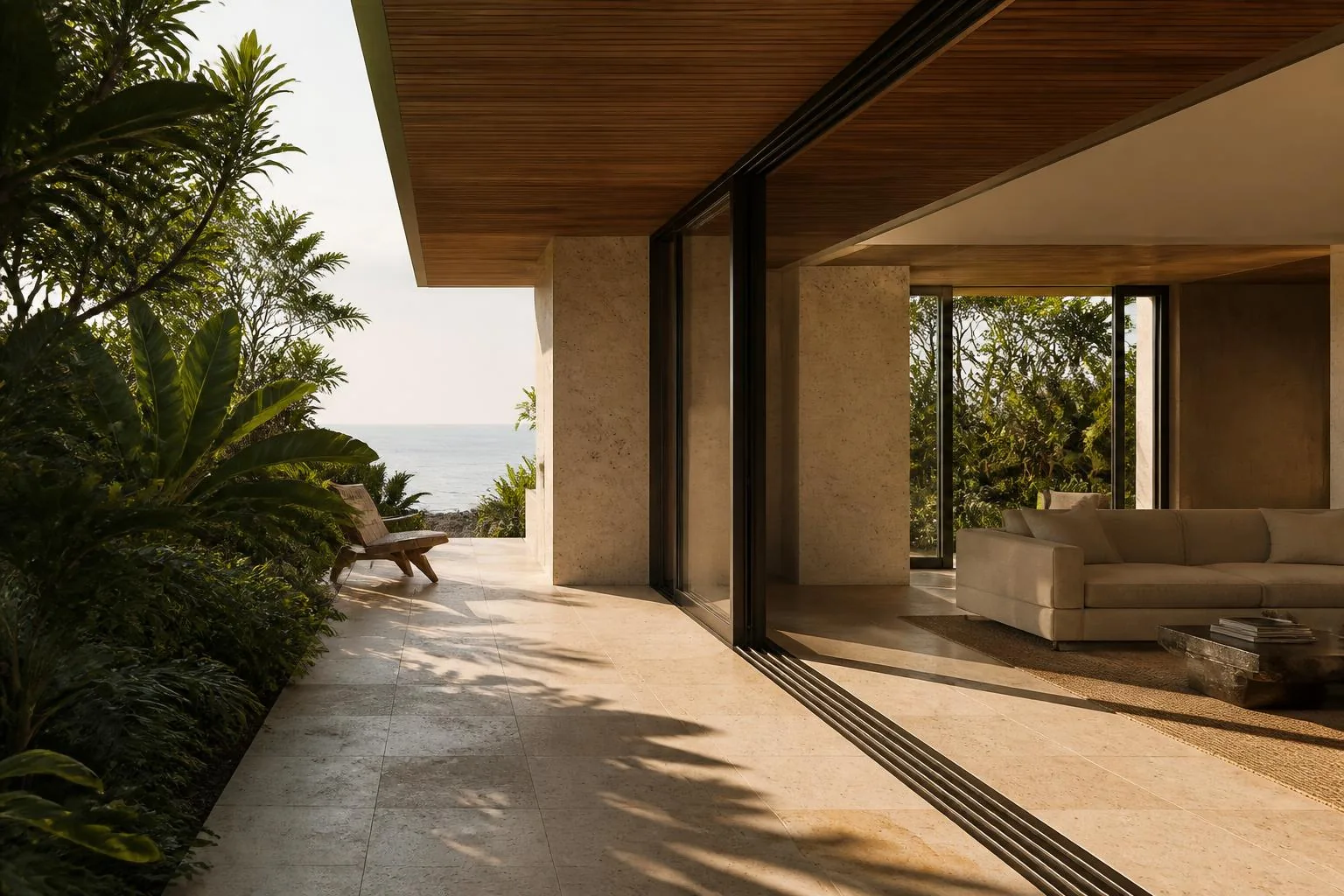
In the Caribbean, a house is lived at the threshold: terraces that function as living rooms, kitchens that open up, dining rooms that move outside as the sun goes down. If interior and exterior are specified separately, that threshold becomes a visible seam.
Designing the transition means deciding how the floor continues, how the level change and drainage are resolved, how the edge of a piece of furniture a metre from the rain is protected, and how a space that loses natural light by seven in the evening is lit. It also means accepting that some beautiful materials should stay indoors, and finding an outdoor family of finishes that speaks to them without pretending to be the same thing.
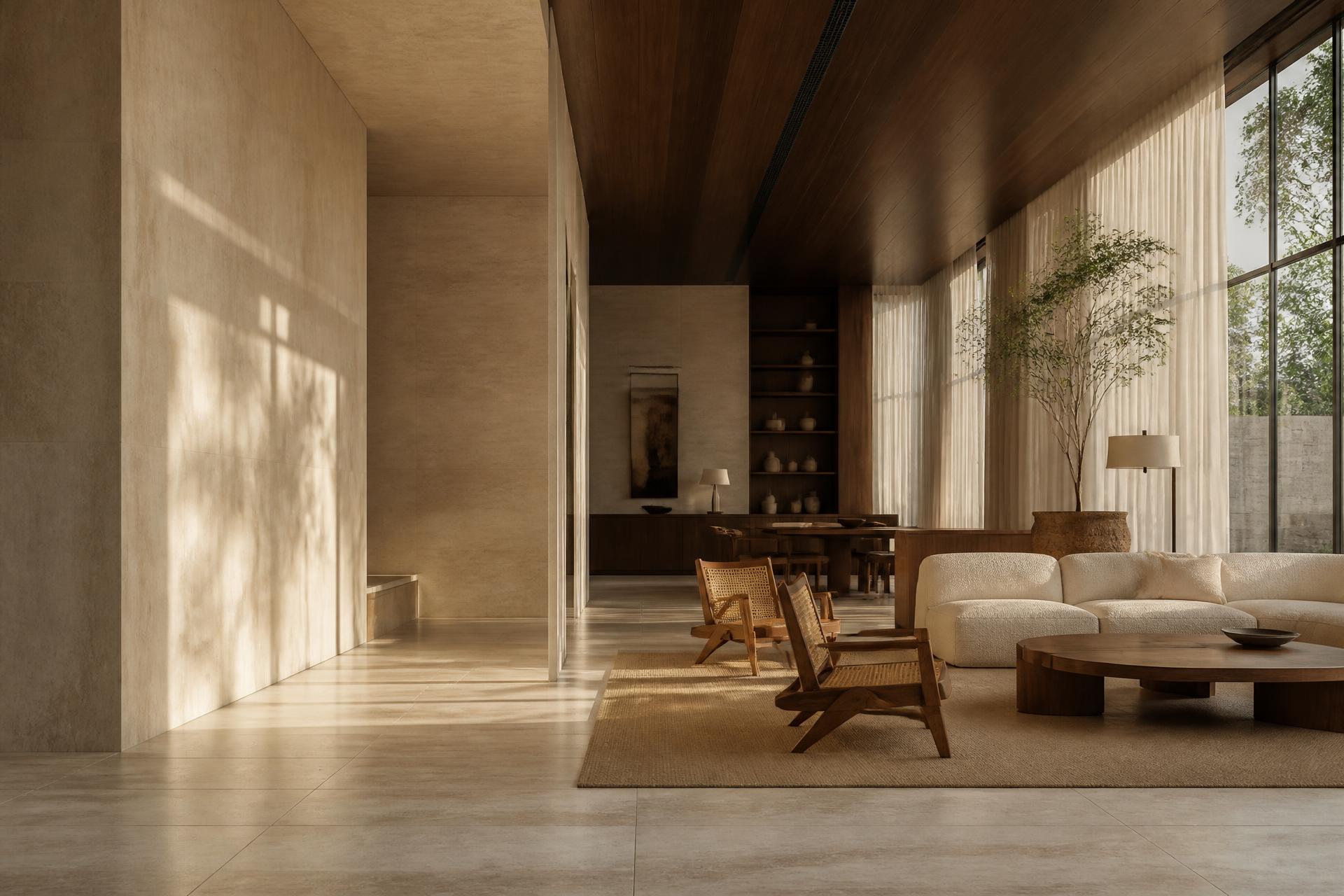
That continuity is, in practice, one of the clearest markers of a well-integrated project. You can see it in several of the projects gathered in Transformations, where the relationship between living room, terrace and view was resolved as a single decision.
Maintenance is also part of the project
A responsible project hands over, along with the house, the way to care for it. Not as a bureaucratic manual, but as a set of criteria: what to clean with what, which surfaces should be resealed and how often, which hardware to check yearly, which fabrics can be washed and which can't.
When the owner doesn't live in the property year-round, that care needs to be realistic. A seasonally occupied house needs materials that tolerate periods of low ventilation and decisions that don't depend on weekly supervision. It's a difference of judgment, not of budget: there are costly solutions that demand a lot of maintenance and understated solutions that demand very little.
When specification protects a property's value
In a high-end residence, finishes aren't the last layer of the project: they're a large part of its perceived value and of its real value. An interior that ages well retains its price, shows better, and avoids the quiet expense of replacing pieces every few years.
That protection is built earlier, at the design table, when every material is chosen for a reason that can be explained. It's the same criterion we apply when defining scope in a full renovation and when designing custom furniture for a specific space.
If you're developing or renovating a property in the Mexican Caribbean, a correct specification from the outset can prevent costly decisions during construction. You can learn how we work in What We Do or write to us through Contact to review your case.